
Wood vs. Composite Deck: Which Is Better?
Summary
Wood and composite decking can both provide homeowners with an attractive and functional outdoor living space. Wood generally costs less upfront but requires ongoing cleaning, staining, and maintenance. Composite decking usually costs more initially but requires less long-term maintenance and does not need regular staining.
The best choice depends on your budget, how long you plan to stay in your home, and how much maintenance you're willing to do. Homeowners should also consider factors such as sun exposure, surface heat, railing choices, existing deck framing, and the specific manufacturer's installation and warranty requirements.
A properly built and maintained wood deck can provide many years of enjoyment. Composite may be worth the additional investment for homeowners who plan to stay in their home longer and prefer to reduce future maintenance.

This custom composite deck features matching composite railings, comfortable outdoor furniture, and a patio umbrella, creating a durable, low-maintenance outdoor living area perfect for relaxing and entertaining.
If you’re planning a new deck, one of the biggest decisions you’ll make is whether to use traditional wood or composite decking.
Homeowners often ask us, “Which one is better?”
After more than 20 years of repairing, remodeling, and rebuilding homes throughout the Kansas City metro, our answer is: it depends on the homeowner.
We generally prefer the appearance and lower-maintenance qualities of composite decking, but that doesn’t mean a wood deck is a poor choice. Wood decks have been around for a very long time, and a properly constructed and maintained wood deck can provide many good years of outdoor enjoyment.
The better question may be:
Which decking material makes the most sense for your budget, your home, how long you plan to live there, and how much maintenance you’re willing to do?
The Biggest Difference Is Often Upfront Cost vs. Ongoing Maintenance
Composite decking typically costs more upfront than pressure-treated wood.
That initial price difference can make wood attractive, particularly when the homeowner has a limited project budget. But the initial construction cost isn’t the only expense to consider.
Wood requires ongoing maintenance.
Depending on the wood, finish, weather exposure, and manufacturer recommendations, that can include:
-
Regular cleaning
-
Periodic pressure washing or other appropriate cleaning
-
Staining or sealing
-
Replacing individual boards as they deteriorate
-
Maintaining wood railings and balusters
Some deck stains and sealers require another application every few years. That means purchasing materials and investing your own time or paying someone else to clean and refinish the deck.
Composite doesn’t eliminate deck maintenance. It still needs periodic cleaning and inspection. However, most composite decking doesn’t require the recurring staining and sealing associated with traditional wood decking.
Over many years, that difference can become significant.
Does That Mean We Always Recommend Composite?
No.
We don’t believe homeowners should feel as though they can’t have a beautiful new deck because their budget doesn’t include premium composite decking and an aluminum railing system.
A simple wood deck can create a great outdoor living space.
If you’re comfortable maintaining it properly, wood may provide many years of enjoyment while allowing you to keep the initial project cost lower.
There are also circumstances where we think putting substantially more money into composite may not make sense.
For example, wood may deserve serious consideration if:
-
You’re flipping a house.
-
You expect to move within a relatively short period.
-
Keeping the initial project cost down is a priority.
-
You don’t mind periodically maintaining the deck.
-
You simply prefer wood.
-
Other improvements to the home are a higher priority for your budget.
The exception may be a higher-end property where the materials and finishes buyers expect should also be considered. A basic wood deck could potentially feel out of place if comparable homes in the neighborhood have higher-end outdoor living spaces.
That’s why we prefer to discuss the homeowner’s goals rather than automatically recommend the same material to everyone.
When Does Composite Start Making More Sense?
If you expect to remain in your home for many years, the calculation changes.
You’re more likely to personally experience multiple maintenance cycles on a wood deck. The time and expense involved in cleaning, preparing, staining, and maintaining the wood become part of the true cost of owning it.
This is also where personal preference matters.
If budget isn’t the deciding factor, we encourage homeowners to think seriously about one simple question:
How willing are you to pressure wash, prepare, and restain your deck periodically for years to come?
If that doesn’t bother you, wood remains a reasonable option.
If you already know you’re going to dread it—or you’ll have to hire someone every time it needs to be done—the additional upfront investment in composite may be worthwhile.
In our own experience, we haven’t had homeowners tell us they regretted choosing composite because of the maintenance. The regrets we’ve encountered are more often from wood-deck owners when it comes time to clean and refinish the deck again.
That’s our experience, however, and shouldn’t be interpreted to mean that every homeowner will prefer composite or that composite products are problem-free.
Wood Decks Can Last a Long Time When They’re Maintained
One danger in comparing these materials is making wood sound temporary and composite permanent.
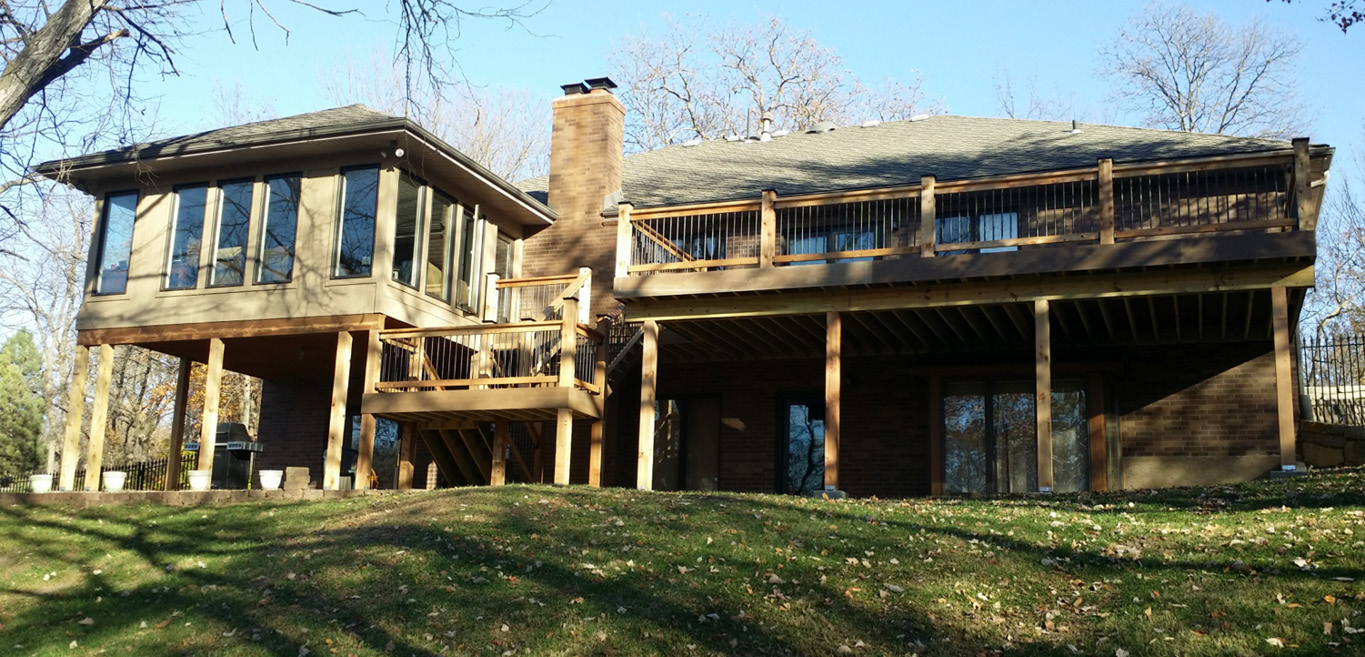
A spacious backyard deck and sunroom create an extended outdoor living area across the length of the home.
Neither description is accurate.
Pressure-treated lumber is specifically manufactured for exterior applications, and appropriate maintenance helps protect wood from the effects of moisture and sunlight. Guidance on refinishing intervals varies depending on the wood, product, finish, exposure, climate, and amount of use. Some commonly available deck finishes call for reapplication every few years.
The important point isn’t that every wood deck needs to be stained on an identical schedule.
It’s that maintenance is part of owning a wood deck.
A homeowner willing to perform that maintenance shouldn’t feel pressured into purchasing composite simply because it is considered an upgrade.
Composite Is Low Maintenance, Not No Maintenance
We also don’t like the phrase “maintenance-free deck.”
Your deck is outside 365 days a year.
Leaves, pollen, dirt, moisture, food, pets, furniture and other debris don’t disappear because the decking is composite.
Composite decking still needs cleaning, and the entire deck should be periodically inspected. The structural framing, connections, stairs, railings and other components matter regardless of what material is used for the walking surface.
The advantage is that composite generally eliminates one of the larger recurring maintenance jobs associated with wood decking: refinishing the decking itself.
Is Composite Decking Hotter Than Wood?
This deserves more attention than it sometimes receives, particularly in the Kansas City summer.
Composite decking can become quite hot when exposed to direct sunlight. However, there isn’t one accurate temperature difference that applies to every wood and composite deck.
Color matters. Product composition matters. The amount and duration of direct sunlight matter. Some newer products also incorporate technologies intended to reduce heat buildup.
Testing illustrates just how much variation can exist. In one Missouri contractor’s field test of TimberTech products in direct summer sun, different composite colors reached substantially different surface temperatures under the same general conditions. That doesn’t establish what another manufacturer’s product—or your future deck—will reach, but it demonstrates why “composite is hot” is too simplistic.
If your deck receives intense afternoon sun, we recommend considering this before selecting a product or color.
This can be particularly important if:
-
Your family frequently walks outside barefoot.
-
You have young children.
-
You have pets that will regularly walk or lie on the deck.
-
The deck has little or no shade.
-
You’re considering a very dark decking color.
Rather than relying solely on a photograph or small sample viewed indoors, ask questions about the particular product you’re considering and review the manufacturer’s current information.
Don’t Assume Every Composite Product Is the Same
“Composite decking” describes a category, not a single product.
Different manufacturers—and different product lines from the same manufacturer—can have different specifications, warranties, colors, textures, heat characteristics, installation requirements, and price points.
That’s one reason homeowners should know exactly what product is included in a contractor’s proposal.
A lower-priced composite and a premium composite aren’t necessarily equivalent simply because both are called composite.
The same principle applies to wood. Species, grade, treatment, moisture content, installation, maintenance, and exposure can all affect performance.
Independent research into wood and composite materials is also available through the USDA Forest Products Laboratory, which conducts scientific research on wood, wood products, and advanced composites.
Can You Put Composite Decking on an Existing Wood Deck Frame?
Sometimes.
As we discussed in our article about whether to repair or replace a deck, homeowners sometimes have structurally sound framing and want to replace only the decking.
Switching from wood decking to composite can be an option, but the existing frame needs to be evaluated first.
One important consideration is joist spacing.
It’s sometimes said that composite decking always requires joists 12 inches on center while wood can be installed over joists 16 inches on center. That’s too broad.
For example, current Trex guidance generally permits up to 16-inch-on-center joist spacing for standard residential composite decking installed perpendicular to the joists, while diagonal installations can require 12-inch spacing. TimberTech likewise specifies a maximum of 16 inches on center for many standard installations and notes that 12-inch spacing can provide a more rigid feel. Requirements can differ by product and installation pattern.
That’s why we don’t believe a contractor should assume an existing deck frame is automatically suitable for whichever composite product the homeowner selects.
The contractor should evaluate the existing structure and compare it with the current requirements for the actual decking product being installed.
That evaluation may include:
-
Condition of the existing joists and beams
-
Joist spacing
-
Whether the framing is level and in plane
-
Decking direction or pattern
-
Blocking and additional framing requirements
-
Existing structural connections
-
Ledger and flashing conditions
-
Support posts and footings
-
Stair framing
-
Manufacturer installation requirements
-
Applicable building requirements
Sometimes additional framing can be added. In other situations, what initially appeared to be a simple decking replacement may reveal structural issues that should be addressed first.
Don’t Forget About the Railing
The decking gets most of the attention, but railing can make a major difference in both appearance and future maintenance.
Our personal favorite combination is composite decking with Westbury aluminum railing.
We like the clean appearance, and we’ve experienced relatively few issues with this combination.
Traditional wood railing can certainly be used, but homeowners should understand what they’re agreeing to maintain.
Wood railings contain numerous individual surfaces. Balusters can bow or loosen over time, and cleaning and restaining all of those individual components can become tedious.
That maintenance is one reason we like aluminum railing when the homeowner’s budget allows for it.
Another option is using composite sleeves or covers over treated structural posts. When exposed treated 6×6 posts are incorporated into a design, we also like protecting the tops with appropriate caps so rainwater isn’t continually sitting on exposed end grain.
Again, these are preferences based on our experience—not a declaration that every deck needs to be constructed this way.
Think About the Entire Deck, Not Just the Deck Boards
Homeowners sometimes become so focused on selecting the decking that the structure underneath it becomes an afterthought.
We would rather see someone have an appropriately constructed wood deck than spend heavily on premium decking installed over inadequate framing.
The decking is only one component of the system.
Posts, footings, beams, joists, ledger connections, flashing, fasteners, stairs and railings all contribute to the safety and longevity of the finished deck.
Homeowners who want to better understand the structural components of a residential wood deck can also review the American Wood Council’s Residential Wood Deck Construction Guide, which covers decking, joists, beams, posts, footings, ledger attachments, guards, stairs, and other structural components.
This becomes particularly important when remodeling an older deck.
We’ve encountered older decks throughout the Kansas City area where the visible deck boards weren’t actually the biggest problem.
We’ve found deteriorating posts, unsafe stairs, structural movement and moisture damage hidden where decks were attached improperly to homes. In some cases, older ledger boards were installed directly against siding without the flashing and drainage details we would expect today, allowing moisture to become trapped where homeowners couldn’t see it.
Putting beautiful new decking over a structure with unresolved problems doesn’t solve those problems.
What About the Posts Underneath a Composite Deck?
Choosing composite decking doesn’t necessarily mean everything underneath the deck is also composite.
Treated lumber remains commonly used for deck framing.
We’ve also encountered many older decks with cedar support posts placed directly into soil or concrete. In our Kansas City-area experience, those locations can become failure points as moisture remains around the base of the post.
When replacing failed posts, one approach we’ve used is temporarily supporting the deck, replacing the deficient footing as necessary, extending the concrete pier above grade, and using an appropriate galvanized post base to separate the wood post from standing moisture.
Details like these aren’t as exciting as choosing a decking color, but they’re important to the finished project.
Wood vs. Composite for a Flip or Short-Term Home
If you’re remodeling a house to sell or know you’ll be moving relatively soon, we’d think carefully before automatically investing in the most expensive decking package.
You may not own the property long enough to personally benefit from years of reduced maintenance.
A properly constructed wood deck may be entirely appropriate.
On the other hand, the home’s price point and neighborhood expectations matter. Buyers considering a higher-end property may expect finishes that are consistent with the rest of the home.
There isn’t a formula that works for every property.
Wood vs. Composite for a Long-Term Home
If you’re planning to stay in your home for many years, composite becomes easier to justify.
You have more time to benefit from the reduced refinishing requirements, and you aren’t simply installing an upgrade for the next owner.
But even then, we don’t believe the contractor should make the decision for you.
Some homeowners enjoy working on their homes. They don’t mind maintaining wood and would rather use the money they save initially for another project.
Others would happily pay more today to avoid refinishing a deck several times in the future.
Neither homeowner is wrong.
Our Favorite Doesn’t Have to Be Your Favorite
If we were selecting based primarily on appearance and manageability over time, our preference is composite decking paired with aluminum railing.
But our preference isn’t the deciding factor.
It’s your house and your budget.
No homeowner should walk away from a conversation with a contractor feeling that a quality deck is outside their reach because they can’t or don’t want to purchase a particular premium material.
Wood remains a legitimate decking option.
Composite remains a legitimate decking option.
The contractor’s job should be to explain the differences, point out structural or installation considerations, help you understand the likely maintenance requirements, and then allow you to make an informed choice.
So, Which Is Better: Wood or Composite?
If keeping the initial cost lower is your priority and you’re willing to perform ongoing maintenance, wood may be the better choice for you.
If reducing future staining and refinishing is important, you expect to remain in the house for many years, and your budget accommodates the higher initial investment, composite may be worth considering.
If money isn’t the deciding factor, we think one of the most useful questions you can ask yourself is:
How much tolerance do I really have for cleaning, preparing, and restaining a wood deck over the years?
Be realistic.
If you don’t mind doing it—or paying someone to do it—a properly maintained wood deck can provide an excellent outdoor living space.
If you already know you don’t want that responsibility, the higher upfront price of composite may make more sense for your household.
A Note About Decking Products and the Information in This Article
This article is intended to provide general educational information and share observations from our experience working on residential decks. It isn’t intended to establish that one decking material, manufacturer, or product is appropriate for every home or project.
Decking products, installation requirements, warranties, maintenance recommendations, expected service life, heat characteristics, and other performance characteristics vary by manufacturer and product line and may change over time. Site conditions, exposure, installation methods, maintenance, structural design, and other factors can also affect performance.
Homeowners should review the current manufacturer’s specifications, installation instructions, care requirements, and warranty information for the specific product being considered and discuss the particular project with an appropriate contractor or other qualified professional before making a final selection.
References to particular products, manufacturers, construction practices, or experiences in this article are provided for general informational purposes and should not be interpreted as a guarantee of performance, suitability, lifespan, or outcome for a particular project.
Need Help Deciding What Makes Sense for Your Deck?
At Absolute Building Concepts, our goal isn’t to convince every homeowner to buy the most expensive decking material.
We’d rather understand what you’re trying to accomplish.
How long do you expect to live in the house? How will you use the deck? How much maintenance are you comfortable performing? What does your budget allow? And if we’re working with an existing deck, is the structure underneath the decking still sound?
Those answers can be more important than simply asking whether wood or composite is “better.”
If you’re considering building, replacing, or remodeling a deck in the Kansas City area, Absolute Building Concepts can evaluate the project, discuss the available options, and help you understand the considerations involved so you can make the final decision that’s right for your home.
If you’re planning a new deck or deciding whether an existing deck should be repaired or replaced, learn more about our deck building and deck repair services in Kansas City.
Comments